

June 26, 2026
A pneumo depth gauge is one of the most common terms diving supervisors and safety officers come across on a spec sheet or panel diagram, yet it is also one of the least explained. It sits quietly on the diver air panel next to the supply gauges, and the whole surface team relies on it during every single dive. If you have ever looked at a panel drawing and wondered what the “pneumo” line actually measures, this article breaks it down in plain terms.
In commercial diving operations, knowing exactly how deep a diver is at any given moment is not a convenience. It is a safety requirement. Surface teams use this reading to manage decompression schedules, monitor the diver’s position relative to the work site, and respond immediately if something changes. That is why the pneumo depth gauge diving setup remains standard equipment across offshore, subsea, and marine construction projects worldwide.
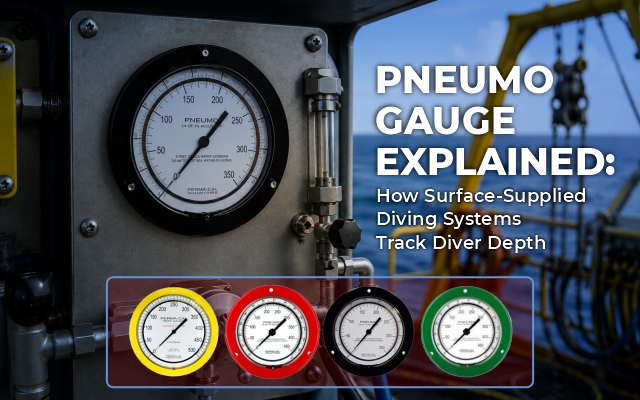
A pneumo, short for pneumofathometer, is a surface supplied diving depth gauge that measures a diver’s depth using gas pressure rather than an electronic signal. A small-diameter hose runs from the surface control panel down through the diver’s umbilical, with its open end fixed near the diver’s chest.
When the surface operator opens the pneumo valve, gas flows down the hose and bubbles out at the diver’s end. Once the valve is closed, water pressure at that depth pushes back up the hose. This backpressure is read on a calibrated gauge at the surface, and because pressure increases in a fixed, predictable way with depth in water, the reading translates directly into a depth value.
There is no battery, no circuit board, and no digital sensor involved. It is a purely mechanical, pressure-based system, and that is exactly why it has stayed the industry standard for decades.
The principle behind every commercial diving depth gauge of this type is straightforward hydrostatics. Pressure in water rises at a constant, known rate for every metre or foot of depth. A pneumo gauge is calibrated against that relationship, so the pressure reading at the surface end of the hose corresponds directly to how deep the diver is.
A gauge snubber, a small needle valve or restrictor, is fitted between the hose and the gauge to protect the mechanism from pressure shocks. An overpressure valve is also built in to prevent damage if the line is blown too hard. These small components are what allow the gauge to stay accurate and durable through repeated use in demanding offshore conditions.
Diving supervisors researching panel specifications often ask why a depth gauge diving panel still relies on a pneumo line instead of an electronic depth sensor, especially when digital instruments are common elsewhere in modern equipment.
The answer comes down to reliability under working conditions. A pneumo system has no battery to fail, no electronics to short out, and no software to malfunction. It works purely on gas pressure and simple mechanics, which means it keeps functioning even in harsh offshore environments where electronic components are more vulnerable to moisture, vibration, and power loss.
It is also a shared reading. Every member of the surface team standing at the panel sees the same depth value at the same time, without depending on a screen, a data link, or a power source. For diving supervisor depth monitoring, this real-time, whole-team visibility is exactly what safety procedures call for.
This is also why the pneumo gauge is closely aligned with IMCA guidance for surface-supplied diving systems. IMCA compliant diving equipment in India is expected to include this kind of dependable, non-electronic depth verification method as part of the overall life support setup, and the pneumo has remained the accepted approach for exactly that reason.
Most panels used internationally, including in India, are fitted with a dual scale depth gauge FSW MSW, meaning the same gauge face displays both feet of seawater and metres of seawater. This matters because diving teams frequently work across projects with different regional conventions, and having both scales on one gauge removes any risk of misreading or manual conversion errors during a live dive.
A dual scale gauge is a small detail, but for a diving supervisor reading depth in real time while managing decompression stops, it removes one more variable from an already demanding task.
A pneumo gauge is never used in isolation. It is built into the wider life support and control system, and understanding where it sits helps make sense of why it appears on so many different types of equipment.
On a Diver Air Panel, the pneumo gauge sits alongside the breathing gas supply gauges and valves. The supervisor operates the pneumo valve directly from this panel, giving a live depth reading without needing any separate instrument.
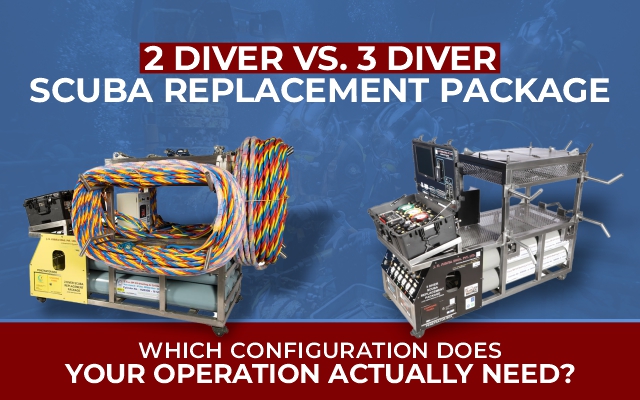
In a Scuba Replacement Package, the pneumo depth gauge is built into the portable air control panel along with the supply valve, regulator, and gas analyzer. Since SRP units are designed for mobile deployment on vessels and platforms, a mechanical, battery-free depth gauge is a natural fit for equipment that needs to work reliably without dependence on charged batteries or external power.
Pneumo-style pressure gauges are also mounted on the outside of diving chambers to confirm internal pressure during decompression and treatment procedures, following the same mechanical principle used for diver depth tracking.
Across all three applications, the same core idea holds. A simple, pressure-based mechanism gives the surface team a dependable, always-visible reading, without adding another point of electronic failure to a safety-critical system.
JK Subsea Engineering Pvt. Ltd. is a trusted diving equipment manufacturer in India, based in Navi Mumbai, building pneumo gauges and full diving panel systems to project specification for offshore and subsea operations.
As a diving equipment manufacturer in Navi Mumbai, our panels, gauges, and life support systems are designed following IMCA guidelines and manufactured under ISO 9001, ISO 14001, ISO 45001, and CE certification. This makes JK Subsea a dependable commercial diving equipment supplier in India for EPC contractors, diving contractors, and offshore project teams sourcing safety-critical instrumentation.
Key reasons procurement teams and EPC contractors work with us:
As a diving panel accessories manufacturer in India, we also supply individual pneumo gauges, snubbers, and overpressure valves as replacement components for existing panels already in service.
A pneumo depth gauge may look like a small dial on a busy control panel, but it represents one of the most dependable pieces of engineering in the entire surface-supplied diving system. Its mechanical, battery-free design is precisely why it has remained the trusted method for tracking diver depth for decades, and why it continues to meet IMCA expectations for safety-critical monitoring.
Whether you are specifying a new Diver Air Panel, sourcing components for an SRP system, or looking for a reliable depth gauge supplier in mumbai for an ongoing project, JK Subsea Engineering Pvt. Ltd. builds this equipment to the standards your operations demand.
Reach out to our team for a technical datasheet or a project-specific quote.
It measures the pressure of gas held in a hose running to the diver, and converts that pressure reading into a depth value using the known relationship between water pressure and depth.
It has no battery or electronic components to fail, works purely on gas pressure, and gives every member of the surface team a shared, real-time reading without depending on a power source or display screen.
A dual scale depth gauge displays depth in both feet of seawater (FSW) and metres of seawater (MSW) on the same dial, so surface teams can read depth correctly regardless of which unit convention a project uses.
It is fitted on Diver Air Panels, SRP portable control panels, and diving chamber exteriors, wherever a real-time, mechanical depth or pressure reading is required.
Yes. We supply pneumo gauges, snubbers, and overpressure valves individually for panel upgrades or replacements, in addition to complete panel and SRP systems.
Contact JK Subsea Engineering Pvt. Ltd. directly through our website or request a technical datasheet, and our team will get back to you with project-specific specifications and pricing.


Fill in your details below to instantly download the product datasheet.