


October 19, 2026
A full gas cylinder can hold 200 bar or more. Most torches, instruments and gas panels need only a small fraction of that. The regulator in between does the pressure reduction, and whether it does it in one step or two decides how steady your outlet pressure stays as the cylinder empties.
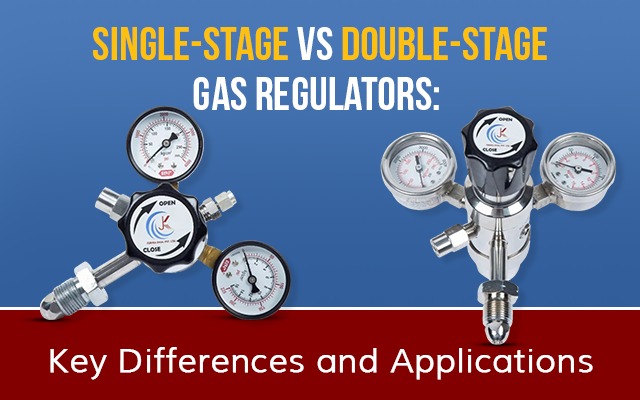
That is the heart of the single stage vs double stage regulator question. A single stage gas regulator is simple, compact and economical, but its outlet pressure creeps upward as the cylinder drains. A double stage gas regulator holds outlet pressure much more steadily, usually at a higher price and with different behaviour under heavy flow. Neither is better in every case. The right choice depends on how long you draw gas, how much you draw, which gas you use and who is watching the system.
Most cylinder regulators work with three parts: a spring, a diaphragm and a valve. The spring pushes on one side of the diaphragm, and the outlet pressure pushes back on the other. When outlet pressure drops below the set point, the diaphragm moves and opens the valve to let more gas through. When pressure recovers, the valve closes.
There is a catch. Inlet pressure also pushes on the valve. So when the cylinder pressure changes, the balance of forces shifts, and the outlet pressure shifts with it. This one detail explains most of the differences between the two designs.
A single stage pressure regulator has one valve, one diaphragm and one spring. The entire pressure drop from cylinder to outlet happens in a single step.
Its defining behaviour is called supply pressure effect. As the cylinder empties and inlet pressure falls, the outlet pressure rises. If you set the regulator on a full cylinder, you will see a slightly higher delivery pressure on a nearly empty one unless you adjust it. On the positive side, single stage designs show relatively little droop when flow changes.
For many jobs this is perfectly acceptable. A single stage unit is a sensible choice when gas is used for short periods, or when re-adjusting the outlet during longer use is practical. If you need a robust unit for supervised work, a single stage high pressure regulator is the type most buyers start by considering.
A double stage pressure regulator is essentially two regulators in series inside one body. The first stage is preset and not user adjustable. It brings cylinder pressure down to a fixed intermediate pressure. The second stage is the adjustable one, and it sets the final delivery pressure.
Because the second stage always sees a nearly constant inlet pressure, the outlet barely reacts when the cylinder runs down. In practice, the supply pressure effect of a two stage design is only a small fraction of that of a single stage unit. Exact values depend on the design, so always check the datasheet of the specific model.
For long runs or unattended supply, a double stage high pressure regulator removes the need for constant outlet adjustment. The two stage gas regulator layout is the reason it can do this.
| Factor | Single stage | Double stage |
|---|---|---|
| Pressure reduction | One step | Two steps in series |
| Outlet stability as cylinder empties | Outlet rises, may need adjusting | Much more stable |
| Droop at high flow | Generally lower | Generally more pronounced |
| Cost and complexity | Lower, fewer parts | Higher, more parts to service |
| Typical fit | Short, supervised or line use | Long, unattended or sensitive use |
It is tempting to assume a two stage unit is simply the premium choice. That overlooks droop, which is the fall in outlet pressure as flow rises from zero to the regulator’s maximum. Two stage designs usually show more droop but a very small supply pressure effect, while single stage designs show the reverse.
So if your process draws a high, variable flow, the flow curve can matter more than cylinder stability. A two stage regulator also carries extra internal parts, which means more to inspect and service over time.
The practical approach is to ask which disturbance hurts your system more: a falling cylinder pressure or a changing flow demand. Then compare supply pressure effect and flow curves on the real datasheets rather than relying on the stage count alone.
When people talk about gas pressure regulator types, they often mean single stage, double stage and line regulators. Each has a natural home.
Single stage regulators tend to suit:
Double stage regulators tend to suit:
In an industrial gas pressure regulator setup, the best layout is often a mix. Regulating at the source acts as the first stage, and a single stage regulator at each use point acts as the second. A gas manifold feeding several lines is a typical example. Avoid placing a two stage regulator at the source and then fitting single stage regulators downstream, because the result behaves like three stage regulation and adds cost without benefit.
The word “stage” causes real confusion in diving. A scuba regulator has a first stage on the cylinder and a second stage in the diver’s mouthpiece. The first stage reduces cylinder pressure to an intermediate pressure, commonly about 7 to 10 bar above ambient, and the second stage reduces that to ambient pressure on each breath. That is a demand valve design, and it is not the same thing as choosing between single and double stage cylinder regulators.
The industrial choice appears upstream, in the cylinder banks, gas panels and distribution systems that supply surface supported diving and breathing gas equipment. When you select a gas regulator for diving applications, the same stability and flow logic applies, plus stricter requirements. Oxygen compatible materials, cleanliness, relief protection and the relevant standard all come into play.
Do not treat air, oxygen and mixed gas regulators as interchangeable.
Good high pressure regulator selection starts with a written requirement, not a product category. Confirm these points before you buy.
Even the right regulator drifts if it is neglected. Seats wear, diaphragms age and gauges lose accuracy. Plan inspection and servicing around how hard the regulator works, keep records, and check gauges on a schedule. Teams that want help with upkeep can look at J. K. Subsea’s maintenance and calibration services alongside the equipment itself.
No. It gives steadier outlet pressure as the cylinder empties, but it usually costs more, has more parts and can show more droop at high flow. Single stage units are often the better fit for short or supervised use.
Inlet pressure acts on the regulator's valve. As it falls, the force balance shifts and the valve admits slightly more gas, which raises the outlet pressure unless someone re-adjusts it.
Yes. Placing one near the source and another at each use point is a recognised way to reduce supply pressure effect in lower flow systems.
Yes. Placing one near the source and another at each use point is a recognised way to reduce supply pressure effect in lower flow systems.
It can be, provided the inlet rating, materials and gas compatibility match the cylinder and the application. The stability trade-off still applies.
The choice between a single stage and a double stage regulator is really a question about your own system. Long, unattended or sensitive use points toward two stages. Short, supervised or already regulated use often makes one stage perfectly sound. Heavy flow means you should read the flow curve before deciding.
If you are weighing options, send your inlet pressure, outlet requirement, gas type and flow to the engineering team through the J. K. Subsea contact, and confirm ratings and compliance against the datasheet for the exact model.
Fill in your details below to instantly download the product datasheet.